
Experiment (AB Testing Platform) Concept
Imagine you’re running an eCommerce website. How would you formulate the price of a product? Would you flip a coin to determine the price or rely on intuition? Your answer would be none, likely. This is because, in modern marketing, every click, every sentence matters, and businesses cannot just rely on their mood or feelings to formulate growth strategies. So, what’s the opposite of guesswork in the marketing world? It’s an A/B testing framework: a structured methodology that deploys user preferences effectively through finely refined data. And no, this is not just reserved for tech-savvy companies; it’s a tool for any business or brand that’s looking at scientific ways and proven solutions to increase their leads and conversions.
What is the A/B testing framework?
A/B testing framework is a structured approach used to compare two versions–A and B of a web page or app by randomly assigning users to each version. The framework helps understand which version is performing better amongst users through metrics like conversions, engagement and more. The framework ensures businesses have a scientific, data-driven approach to measure user response and drive conversions instead of relying on intuition or guesswork. Fundamentally, in this process, the traffic is split between two random groups: one group receives the controlled variation or version A while the second group gets the modified variation or version B. Advanced A/B testing tools then track which version records a better response from visitors: whether through higher conversions, click-through rates (CTR), purchases, engagement, or more. Businesses can leverage A/B frameworks to test and validate headlines, content, CTAs (call-to-action), prices, design, images, and much more. But how can a company design a winning A/B testing framework? Is the same framework applicable to all websites? What factors should be included or excluded?
Why do you need an A/B testing framework?
Have you ever wondered how the likes of Google, Amazon, and Netflix A/B test new features, designs, and more? You’ll agree that it is definitely not random. They most likely leverage a properly defined, sophisticated A/B framework. But, why do they do this? Or, for that matter, why does any company need an A/B testing framework? Can simply conducting the test not be enough? Actually, no!
Industry type
What works for a retail company will not work for a SaaS, and what works for SaaS will not work for eCommerce. This is simply because each industry has diverse needs, and the same testing strategy cannot be applied to every business type. And, because companies operate in vastly different industries, there is a need for a tried-and-tested A/B testing framework that can eliminate guesswork and give actionable data. But, what happens when there is no predefined A/B testing framework in place?
The experiments most likely will yield skewed results or data that adds no value or direction. Not to mention, it could also lead to a colossal waste of time and money. You must also remember that A/B testing is not just about experimenting with a feature or CTA. Companies need to be able to innovate and evolve continuously without compromising their baseline or user experience. An A/B testing framework helps achieve this by optimizing the whole process of experimenting, right from allocating resources, to ultimately deriving data that can help formulate future strategies.
Planned experimentation
Another reason to favor the A/B testing framework is that it can help refine the experimentation process which typically is chaotic and error-prone. By clearly identifying a problem or opportunity, testing the hypothesis, and variants, and analyzing the results, companies can ensure their A/B testing yields results that actually move the needle.
A/B testing framework can also help define ‘success’ for a company by establishing predefined metrics. For instance, imagine a tech company launching a new feature. Now, is a 7% increase in conversion rates enough to validate and implement the new variation, ensuring all other things remain constant? How does the company come up with the ‘7%’ number? What happens if conversions are in a closer range say ‘5%-6%’ but not 7%? Should a second element be tweaked alongside? What’s the projected revenue if the feature is shipped at a 7% conversion rate vs a 5% conversion rate? A/B testing framework can help answer all these questions. Without a framework in place, users may get misdirected, and companies would not know what went wrong, where to look, or how to address changes.
Improved decision making
A lot of businesses are guilty of relying on their gut when it comes to marketing. But gut feelings cannot drive growth–data can. A properly designed A/B testing frame takes the guesswork out and provides concrete evidence of what works and what does not. Rather than speculating or assuming user behavior, businesses can deploy data driven strategies that have a 100% better chance of driving up engagement and bringing in over conversions.
Cost saving
Can you imagine making a huge change to a feature or webpage element and spending thousands of dollars for it to bring you negative ROI? That’s the reality of 100s of businesses today.
Wasted marketing spend is a silent killer. A/B testing framework helps optimize costs by letting business focus on strategies that actually work. Instead of blindly investing in new designs, features and more, companies can test ideas at a smaller scale before rolling them out. This prevents expensive mistakes and ensures every marketing dollar is being spent on strategies that bring in the highest ROI. Short, smarter experiments=Low costs and higher ROI
Successful A/B testing framework (step-by-step)
Define clear goals
Think of this as the ‘why’ of the whole A/B testing process. Why are you testing the CTA (Call To Action)? What is your goal? Is it to increase CTR (Click-Through Rate)? Is it to reduce bounce rates? Understand which pricing works the best? Whatever the reason, your goals will quite literally be the center point and guide the whole experiment.
Formulate a hypothesis
The hypothesis takes your goals a step further by refining them. In this example, your hypothesis, for instance, could be: ‘Changing the CTA button color from blue to green can increase conversions by 20% because green is brighter.’ Remember that formulating a hypothesis is central to the A/B test. And for the same reason it has to be backed by research or analysis. Historical data and user feedback can be a good starting point for formulating your hypothesis.
Identify testing variable
Carefully choose the variable you want to test. In our example, it’s the CTA button. Now here’s what it could look like: Color: Blue vs Green ,Text: ‘Buy now’ vs ‘Add to cart’ Placement: ‘Central vs sidebar. Now, here’s the trick part. If you want to study and analyze how color change is pushing conversions, only that variable should be altered or go for testing. If you, for instance, change the color alongside the text, or change the color alongside placement, or change the color, text, and placement altogether, it would be nearly impossible to isolate which variable change actually caused the conversions to move up. To ensure that the results are not skewed and that the variable test is yielding, ideally opt for only one variable change.
Segment your audience
This is a crucial step in your A/B framework. Segment your audience into two random groups for unbiased results: it could be based on geography, device (mobile vs. desktop), or even behavioral (high spenders vs low spenders).
Create variation
The next step in this A/B testing framework would be to create two variations. Per our example, it would look something like this Controlled version (A): Blue color to 50% of the website traffic , Modified version (B): Green color to the remaining 50% of website traffic
Determine sample size and test timing
Calculate the ideal sample size for your testing using advanced statistical tools. Too small of a sample size can render results meaningless. Conversely, an overtly large sample size can dilute or give skewed results (not to mention, can waste a lot of time and resources). So, ensure you pick the ideal sample size. As far as testing time is concerned, for our example, a period anywhere ranging from 3-7 weeks could be ideal to see any meaningful results. Typically you must keep the testing on until you achieve a 90-95% confidence level.
Conduct the test and track result
Launch your test live, in real life. Ensure that external factors like seasonal trends, promotions, or holiday seasons do not influence the test. Next, start tracking the results. In our case, for CTA, the ideal KPIs would be
Click-through rates, Conversion rates, Time spent on the website
Analyze the results
At this point, your A/B test is nearly complete. Compare the performance of the controlled version against the modified version. For instance, if the green button CTA achieved 25% higher conversions at 8000 visitors, against the blue button CTA that had 10% conversion for the same traffic numbers, then the test data can be treated as statistical evidence to implement version B.
Implement and iterate
Your last step is implementing the changes: apply the winning version across the platform. But remember: The process is dynamic. The testing is officially over but, in reality, it’s not. To have continued success, testing must continue. For instance, the green CTA can be tested alongside a text change. After that, the green button can be tested for placement. After that, the green button can be tested for a permutation and combination of text, color, and placement. You get the gist, right? Now, below is a quick summary of the example we discussed above;
Goal: Increase CTR by 20% ,Hypothesis: A green button will perform better because it’s brighter
Variable: Button color Segmentation: 50% of users see the blue button; 50% see the green
Variation creation: Two identical pages except for the button color
Tracking: Set up CTR and conversion metrics Sample Size: 8000 users per group for statistical significance
Execution: Launch the test and monitor for external factors
Analysis: Results show the green button achieves a 25% higher conversion
Implementation: Adopt the green button and plan new tests for text optimization
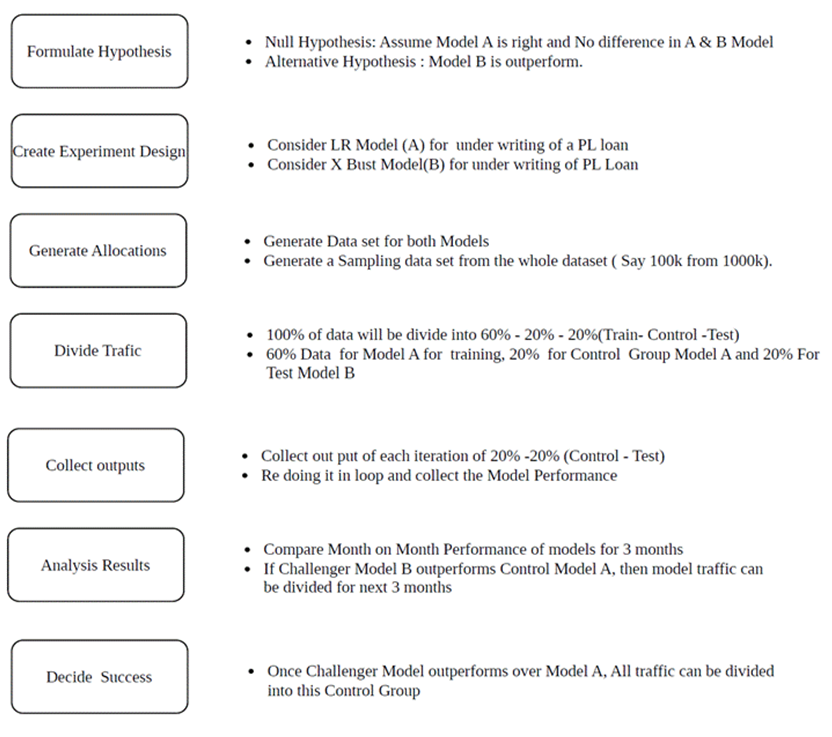
Design Principle of AB Testing Framework
Below is the design principle and step by step of AB testing Strategy.
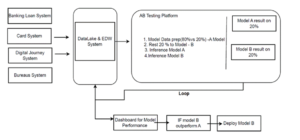
Below is the AB Testing Platform to execute the above Design principle
Summary of AB Testing
A/B testing plays a foundational role in banking and NBFC decision-making, especially where credit risk, policy optimization, and digital customer journeys intersect. In a typical setup, model-level A/B testing (Champion vs. Challenger) is used to evaluate which credit model performs better on live or semi-live traffic, while policy-level A/B testing determines which underwriting rules, cut-offs, or risk strategies should be applied on top of the model outputs. Together, these experiments allow institutions to make evidence-based decisions using real customer data rather than assumptions.
For underwriters, A/B testing helps validate whether a new ML model improves approval rates, reduces defaults, or enhances portfolio quality compared to the incumbent model. For policy makers, it enables controlled experimentation on policies such as score thresholds, risk bands, pricing rules, or bureau-based exclusions—ensuring that business growth and risk remain balanced. Within the digital lending journey, incoming applications are dynamically split into control and test groups, routed through different models or policy variants, and tracked across KPIs such as approval rate, conversion, delinquency, loss rate, and customer drop-off. These experiments often run for weeks or months, allowing statistically significant comparisons before full rollout.
Modern low-code/no-code ML platforms such as Dataiku, Altair, H2O.ai, and cloud-native stacks (Vertex AI, SageMaker) simplify this process by offering built-in experiment design, traffic allocation, metric tracking, and governance. Frameworks like MLflow, Optuna, Feast, and custom A/B orchestration layers integrate with LOS, bureau APIs, and monitoring systems to support real-time data serving and feedback loops. The outcome of A/B testing is faster, safer decision-making—allowing banks and NBFCs to confidently deploy better models and policies, reduce risk, and continuously optimize their digital credit ecosystem.