
Agentic Voice AI refers to voice-enabled artificial intelligence systems that go beyond basic speech recognition or scripted IVR flows and instead act as goal-driven, autonomous agents. These systems combine speech-to-text, large language models, decision logic, and backend integrations to understand customer intent, plan next actions, and complete tasks end-to-end through natural conversations. Unlike traditional IVR or voice bots that follow fixed menus, Agentic Voice AI can dynamically navigate complex scenarios asking clarifying questions, invoking APIs, updating systems of record, and adapting responses based on context, customer history, and business rules. From a business perspective, this transforms voice channels from cost centers into intelligent, self-servicing digital assistants.
In the banking and NBFC ecosystem, Agentic Voice AI delivers significant business value across sales, servicing, and collections. For example, in loan servicing and collections, a voice agent can proactively call customers, explain overdue amounts, negotiate repayment plans, validate consent, trigger payment links, and update the Loan Management System all within a single conversation. In customer support, it can resolve high-volume queries such as EMI schedules, interest certificates, KYC status, or card blocking without human intervention, reducing call-center workload and turnaround time. For business leaders, the impact is measurable: lower operational costs, higher contact-resolution rates, improved compliance through auditable conversations, and enhanced customer experience through 24×7, personalized interactions. As banks scale digital operations, Agentic Voice AI becomes a strategic capability for achieving operational efficiency, regulatory adherence, and consistent customer engagement at scale.
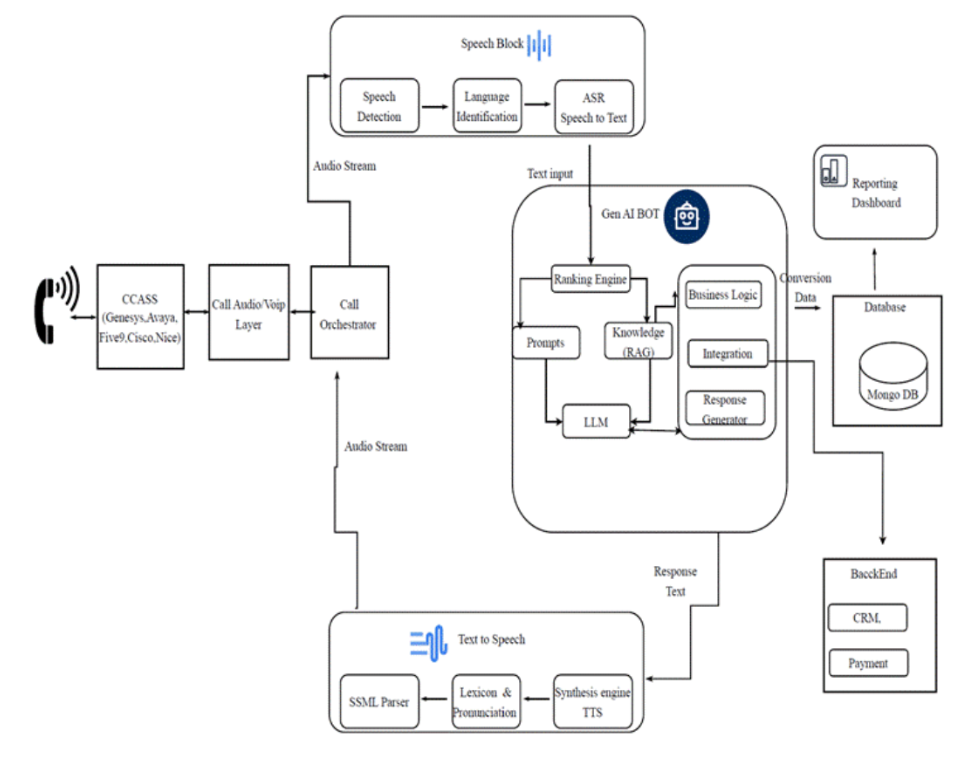
1. Voice BOT Architecture and Design Flow
Component Descriptions :
CCaaS (Contact Center as a Service) provides the telephony + call routing + agent interface needed to run a call center in the cloud. Customer dials a support number. The CCaaS system (e.g., Genesys or Avaya) receives the call via PSTN/SIP. It handles: IVR routing (menu options or intents),Session setup (call ID, ANI/DNIS) ,Call transfer between BOT and live agent ,Recording, compliance, and logging.
Acts as the gateway between the telecom network and the AI voice system, ensuring voice data is available for the BOT to process.In simple terms, CCaaS handles the call plumbing, while the Voice BOT handles the conversation (AI) part.
Call Audio / VoIP Layer- This is the real-time audio transport layer. It streams bidirectional audio between caller and BOT with use of WebSocket, RTP, or gRPC for low-latency streaming. This layer Ensures voice data quality (codec management, jitter buffering).Delivers live audio to the Speech Processing engine for recognition and speech synthesis.
Call Orchestrator Layer- The control layer managing the real-time voice session. It Establishes connection between CCaaS and Voice AI pipeline.Converts VoIP audio packets into a standard audio stream (16-bit PCM/WAV).It Handles session management, timeouts, error handling, and BOT-agent switch logic. This Maintains metadata (caller ID, language, context, session ID). Routes the call audio to the Speech Block and ensures seamless control flow between telephony, AI, and backend systems.
Speech Block– “Hearing & Understanding Human Speech” .The Speech Block is responsible for capturing, cleaning, and converting the customer’s voice into structured, machine-readable text. It bridges the raw audio from the telephony system to the AI language model.
a. Speech Detection(VAD – Voice Activity Detection)
- Detects when the caller starts and stops speaking using real-time amplitude and energy thresholds in the audio waveform.
- Avoids interruptions (BOT won’t talk over the customer).
- Filters out background noise and silence gaps.
- Uses neural VAD models trained on multi-language, noisy datasets. Example: Customer pauses after saying “I want to…” the VAD waits before confirming end-of-speech to avoid truncation.
b. Language Identification (LangID)
- Continuously listens to initial seconds of audio and predicts the spoken language using phonetic and acoustic patterns.
- Can auto-switch between models (e.g., Hindi ↔ English mid-sentence).
- Uses embeddings and multilingual encoders (like XLS-R, Whisper multilingual models). Purpose: Routes the call audio to the correct ASR model and TTS voice for that language.
c. ASR (Automatic Speech Recognition)– Speech → Text
Converts real-time audio streams into timestamped text.
• Works in multiple passes:
- Acoustic Model: Maps sound waves to phonemes.
- Language Model: Predicts probable word sequences (“loan” vs. “lone”).
- Post-Processor: Adds punctuation, expands numbers (“twenty five” → “25”), normalizes text.
- Outputs clean, structured text with confidence scores and entity tagging.
- Advanced ASR uses transformer-based architectures (like Whisper, Conformer, or wav2vec 2.0).Example
Audio: “Can you check my payment for October tenth?”Text: intent=check_payment, date=2025-10-10
Text-to-Speech (TTS) Subsystem-“BOT’s Voice Generation” This is the speech synthesis engine that converts the BOT’s textual response back into natural, human-like audio for the caller.
a. SSML Parser(Speech Synthesis Markup Language)
- Parses markup tags in BOT responses to control intonation, pitch, speed, pauses, and emphasis.
- Enables emotional tone (friendly, empathetic, professional).
Example: <emphasis level=”moderate”>Thank you!</emphasis> sounds warmer than flat text.
b. Lexicon & Pronunciation Engine
- Maintains a dictionary of custom pronunciations for organization-specific words: product names, acronyms, or regional names.
- Uses phoneme mapping to ensure clarity. Example: “L&T Finance” pronounced as “Ell and Tee Finance,” not “Land Finance.”
c. Synthesis Engine (TTS)
Core model that generates waveform audio from text.Mostly two major approaches Technology adopt.Real-time audio stream sent to the Call Orchestrator, then back to the caller. Speech enriched with tone, emotion, and natural pauses for a human-like experience.
- Concatenative / Parametric (older): Pre-recorded human speech stitched together.
- Neural / End-to-End (modern): Uses deep learning (Tacotron 2, FastSpeech, VITS, or Vall-E) to generate lifelike speech.Produces 16kHz or 8kHz audio streams depending on telephony requirements.Supports real-time streaming starts speaking while text is still being processed (low latency <300 ms).
Gen AI BOT Layer- – “The Brain of the Voice AI” .This layer is where the intelligence, reasoning, and personality of your Voice BOT live. It interprets the text from ASR, decides the best response, retrieves knowledge, and crafts replies.
a. Prompts
Detailed level of prompt was mentioned in earlier chapters. But here it is Prompts that BOT internally works instead of human
- Define the system role, tone, and context of the BOT.
- Contain instruction sets such as:
○ “You are a helpful finance assistant.”
○ “If the user asks for payment details, use the CRM API.”
Can be dynamically filled with context variables (customer name, account type, language).
b. LLM (Large Language Model)
- Central reasoning engine (e.g., GPT-based, Llama, Claude, Gemini). Various LLM Models are being considered, like GPT-4.0, Gemini 3.5 Flash, etc.
- Performs intent understanding, context tracking, dialogue generation, and multi-turn reasoning.
- Understands unstructured queries and responds conversationally.
- Continuously learns via prompt chaining and fine-tuning. Example: Input: “I missed my EMI what happens now?” LLM reasoning: Detects missed_payment, retrieves policy → generates empathetic reply.
c. Knowledge (RAG – Retrieval Augmented Generation)
- Augments the LLM with factual, enterprise-specific data.
- Uses vector search or semantic retrieval to pull relevant documents, FAQs, or KB entries.
- Injects this information into the LLM prompt to ensure accuracy and grounding.
Example: LLM fetches current interest rate policy from internal knowledge base before replying.
d. Ranking Engine
- Evaluates multiple possible responses (from LLM or RAG).
- Uses relevance, factual accuracy, sentiment, and compliance as ranking criteria.
- Selects the most confident, contextually appropriate response before sending it to TTS.
Integration & Business Logic Layer– Connects BOT intelligence with enterprise systems with various APIs - Executes real actions like:
○ CRM data lookup
○ Payment processing
○ Ticket creation
○ Account validation - Applies business rules (eligibility, policy logic, compliance validation).
Database & Reporting– This Stores and monitors the BOT’s performance and call insights.
- MongoDB: stores conversational data, user states, logs.
- Reporting Dashboard: tracks KPIs like call volume, containment, satisfaction.
- Conversion Data: captures BOT success metrics and analytics.
Final Flow:
- Customer speaks → Audio captured via CCaaS.
- Call Orchestrator streams audio to Speech Block.
- ASR converts it to text → passed to GenAI BOT.
- BOT generates a reply → passed through the TTS system.
- Synthesized voice returned to caller in real-time via CCaaS.
Data Exchange Summary
| Layer | Input | Output | Key Action |
| Speech Block | Voice Audio | Text+Intent-ready structure | Converts human speech to text |
| Gen AI BOT | Text | Smart Text Response | Think,Reasons and Crafts Reply |
| TTS Subsystem | Text | Natural Voice Audio | Converts replay back to speech |
Conclusion
Agentic Voice AI is redefining how enterprises manage customer interactions by combining speech technologies, large language models, decision intelligence, and seamless enterprise integrations into a unified conversational platform. Unlike traditional voice bots that rely on predefined scripts, it can understand context, reason through complex requests, execute business workflows, and deliver personalised responses in real time.